
Organic Pigments for Plastics: The Complete Selection Guide
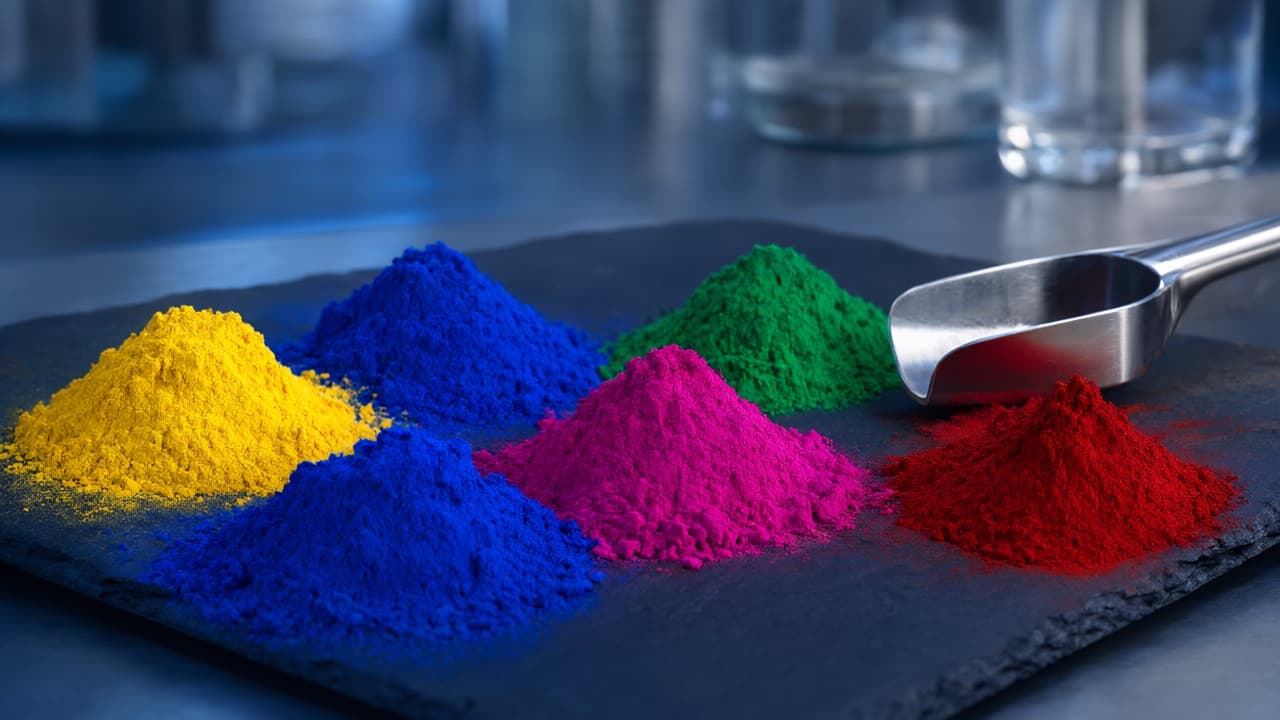
Two molded parts can use the same resin, the same machine and the same masterbatch dosing — and end up with completely different service lives. The variable that decides the outcome is rarely the plastic. It is the organic pigment inside it, chosen for (or against) the chemistry of the application. This guide condenses the selection logic our technical team uses daily: pigment families, processing windows, fastness requirements and the dispersion details that separate a stable shade from a field complaint.
Why the Chemistry Class Comes First
Organic pigments are insoluble particles engineered at the molecular level, and each family carries its own balance of shade, fastness and cost. Before comparing individual grades, narrow the field by chemistry:
- Monoazo pigments (e.g. Pigment Yellow 1, Pigment Red 3) — economical, bright yellows and reds for indoor, moderate-heat applications.
- Disazo pigments such as Pigment Yellow 83 — high strength and clean shades, widely used in packaging where cost-per-color matters.
- Phthalocyanines — Pigment Blue 15:3 and Pigment Green 7 are the industry's workhorse blue and green: excellent lightfastness, heat stability and chemical resistance at low cost-in-use.
- Quinacridones — Pigment Red 122 and Pigment Violet 19 deliver magenta-to-violet shades with outstanding outdoor durability.
- Perylene and perinone — Pigment Red 179 and its relatives combine deep shade with 300 °C-class heat stability, ideal for engineering polymers.
- DPP (diketopyrrolopyrrole) — Pigment Red 254 is the benchmark saturated red for automotive and high-durability goods.
- Carbazole violet — Pigment Violet 23 gives an exceptionally clean, strong violet used for shading across the palette.
Match Heat Stability to the Processing Window
The pigment must survive the worst moment in the barrel, not the average one. As a rule of thumb:
- PE / PP / PVC / PS: 180–260 °C — monoazo and disazo grades are viable; phthalocyanines and quinacridones add margin.
- ABS / PMMA / PC blends: 240–280 °C — move to phthalocyanines, quinacridones and high-grade azos.
- PA / PET / PBT and other engineering polymers: 280–320 °C — perylenes, DPP grades, phthalocyanines and select quinacridones only.
Two practical warnings: heat stability drops at lower concentration (tint shades degrade first), and it interacts with lightfastness — a pigment that passes heat in the dark may fail outdoors at the same dose.
Lightfastness and Weathering: Be Honest About the Exposure
Rate the real exposure before the shade:
- Indoor goods and packaging: most azo families perform adequately; blue/green phthalocyanines overperform.
- Outdoor profiles, siding, automotive interior: quinacridones, perylenes, DPP and phthalocyanines; expect blue-wool ratings of 7–8 only from the top grades in each family.
- Long-term exterior with color retention targets: consider inorganic-reinforced systems, or combine the colorant with UV absorbers and HALS stabilizers in the formulation.
Migration, Bleed and Compliance
Because organic pigments are insoluble, migration problems mostly trace to incomplete dispersion or to additives that carry partial solubility. Still, check:
- Bleed into adjacent parts in contact applications (gaskets, closures).
- Food-contact and toy compliance for the specific grade — ask for the declaration, not a datasheet summary.
- Heavy-metal and aromatic-amine position of the chemistry — modern high-performance families (phthalocyanine, quinacridone, DPP) are inherently clean here.
Dispersion Quality Decides the Outcome
The same pigment can look premium in one plant and mediocre in another. When auditing a colorant or a masterbatch:
- Check filter pressure rise and screen residue on the actual processing line.
- Compare masstone vs. tint strength — a large gap signals poor development.
- Look for specks and flooding in thin sections.
- Confirm the carrier compatibility of the masterbatch with your resin (melt flow, polarity).
When You Need the Color to Change: Thermochromic Effects
A growing share of plastics projects now ask for reversible color change — cold-chain indicators, temperature-warning handles, playful packaging. Thermochromic pigments are microencapsulated systems (leuco dye + color developer + co-solvent) rather than classical organic pigments, and they follow their own selection logic of reversal temperature, substrate and fatigue life. Our group maintains a dedicated specialty portal for this family: browse the thermochromic pigment range on ThermoColors for reversal temperatures from −5 °C to 65 °C, color developers and composite systems.
FAQ
Q: Can I replace a heavy-metal inorganic pigment with an organic one? Usually yes for shade, but verify heat stability and opacity — organics are more transparent and sometimes less heat-resistant. Compensation strategies exist for most polymer/shade pairs.
Q: Why does the same pigment shift shade between PP and ABS? Crystallinity, polarity and processing temperature change crystal form development and dispersion quality. Always approve the shade in the final polymer, at final concentration.
Q: What dosage should I start with? For full shades, 0.5–2% pigment loading in masterbatch terms is typical; tint shades start far lower — where heat stability must be re-verified.
📞 Contact Us
For samples, technical information, or business cooperation, please contact us through the following channels:
- Company Name: Aolong Chemical Co., Ltd.
- Email: sales@aolongchemical.com
- Phone: +86 571 86690377
- Website: www.aolongchemical.com
- Address: No. 1788 Jinggang Road, Shushan District, Hefei, Anhui Province, China
Aolong Chemical — supplying azo, phthalocyanine, quinacridone and high-performance organic pigments for plastics, inks and coatings worldwide.