
Organic Pigments, Inorganic Pigments, and Solvent Dyes: Comprehensive Comparison
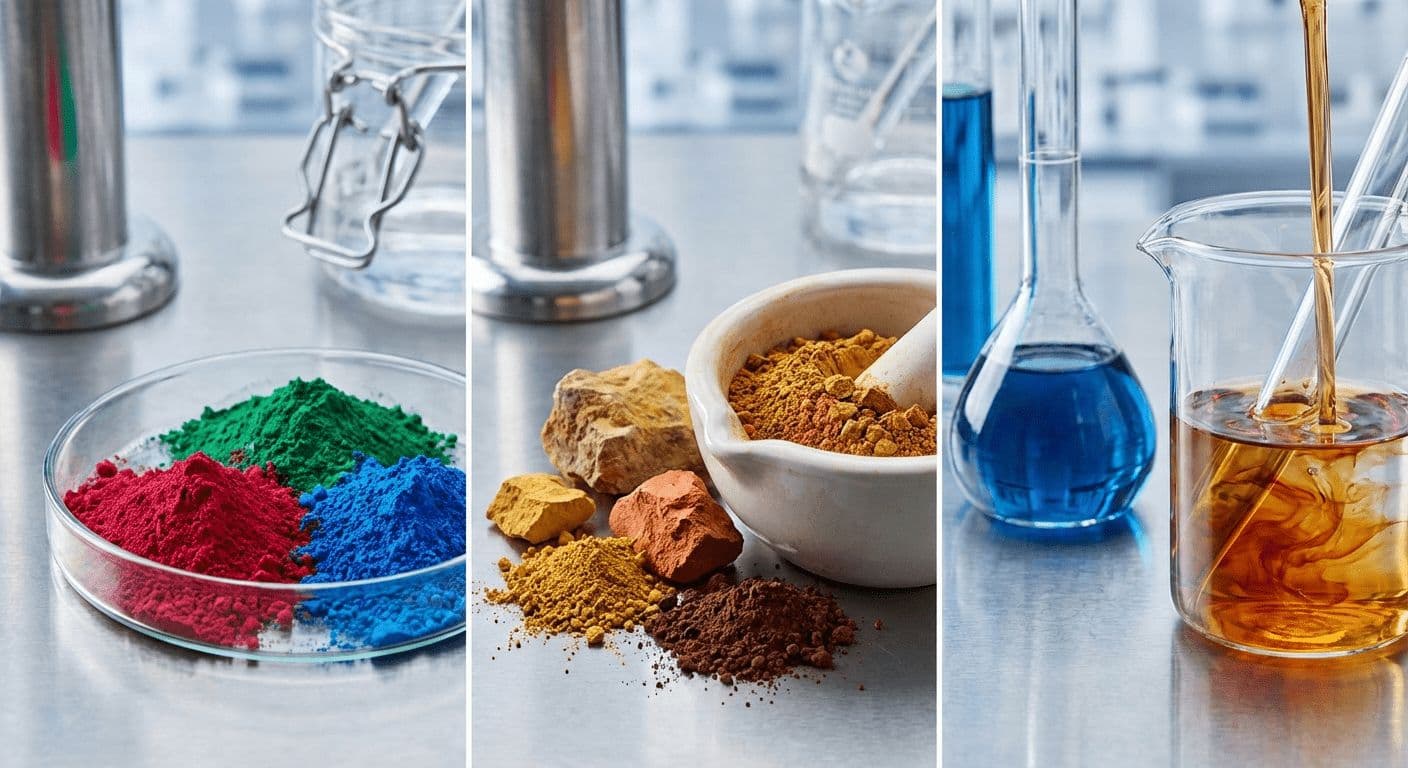
In modern industrial production, color is not just a visual experience, but an important component of product value. Whether in packaging materials, textiles, plastics, or coatings, color plays a crucial role. However, do you truly understand to differences between the three main materials that give products their color: organic pigments, inorganic pigments, and solvent dyes?
The Three Pillars: Organic Pigments, Inorganic Pigments, and Solvent Dyes
1. Organic Pigments: Representatives of Vibrant Colors
Organic pigments are pigments made from organic compounds, known for their vibrant colors and high transparency. These pigments typically feature excellent color saturation and gloss, capable of creating stunning visual effects.
Chemical Structure Characteristics
The molecular structure of organic pigments is primarily based on the following compound categories:
-
Azo Pigments: Containing -N=N- azo functional groups, these are the largest category of organic pigments. Classified by the number of azo groups into monoazo, disazo, and polyazo pigments. Common examples include Yellow G and Permanent Yellow, with molecular structures containing aromatic rings and azo bonds, producing color through conjugated systems.
-
Phthalocyanine Pigments: Pigments with phthalocyanine rings as their core structure, featuring highly symmetric planar molecular structures. Phthalocyanine Blue and Phthalocyanine Green are typical representatives, with central metal coordination sites that can bind different metal atoms (such as copper, zinc, etc.), forming stable complex structures.
-
Anthraquinone Pigments: High-performance pigments based on anthraquinone skeletons, offering excellent light and heat resistance. The molecules contain anthraquinone ring systems, with color and performance adjusted by introducing different substituents.
-
Quinacridone Pigments: Pigments with quinone imine structures, featuring vibrant colors and excellent weather resistance. The molecular structure contains multiple aromatic rings and nitrogen atoms, forming stable conjugated systems.
Preparation Methods
The preparation of organic pigments mainly includes the following steps:
-
Synthesis Reaction: Generating pigment precursors through chemical reactions. For example, azo pigments are prepared through diazotization and coupling reactions; phthalocyanine pigments are formed through condensation of phthalonitrile or phthalic anhydride with metal salts.
-
Pigmentation Processing: Applying physicochemical treatment to crude pigments, including:
- Acid Treatment: Using acid to remove impurities and improve crystal structure
- Solvent Treatment: Using organic solvents to regulate pigment particle size and crystal form
- Surface Treatment: Adding surfactants or resins to enhance dispersibility and stability
-
Post-processing: Including filtration, washing, drying, crushing, and other processes to obtain final pigment products meeting specifications.
Main Characteristics:
- Vibrant colors with high saturation
- Good transparency, suitable for multi-layer application
- Relatively lower light and weather resistance
- Good environmental performance, free of heavy metals
- Relatively higher price
Application Fields: Printing inks, coatings, plastics, textiles, and other areas requiring high color vividness.
2. Inorganic Pigments: Symbols of Stability
Inorganic pigments are made from metal oxides or salts, renowned for their excellent stability and durability. While inorganic pigments lack the vibrancy of organic pigments, they excel in various harsh environments.
Chemical Structure Characteristics
The chemical structure of inorganic pigments is primarily based on the following compound categories:
-
Oxide Pigments: Compounds formed by metals combined with oxygen, such as titanium white (TiO₂), iron oxide red (Fe₂O₃), chromium oxide green (Cr₂O₃), etc. These pigments feature stable crystal structures, producing color through electron transitions.
-
Sulfide Pigments: Compounds formed by metals with sulfur, such as cadmium yellow (CdS), cadmium red (CdSe·CdS), etc. Sulfide pigments have semiconductor properties, with their energy band structure determining optical characteristics.
-
Metal Salt Pigments: Including chromates (such as lead chromate yellow PbCrO₄), molybdates (such as molybdenum chromate red), etc. These pigments produce color through metal ion coordination structures.
-
Complex Oxide Pigments: Such as cobalt blue (CoAl₂O₄), zinc yellow (ZnCrO₄), etc., featuring spinel structures with excellent thermal and chemical stability.
Preparation Methods
The preparation of inorganic pigments mainly includes the following methods:
-
Solid-state Reaction Method: Performing solid-state reactions of metal oxides or salts at high temperature. For example, titanium white powder is prepared through either chloride process or sulfate process. The chloride process is chlorinating titanium ore to titanium tetrachloride, then oxidizing it to titanium dioxide; the sulfate process dissolves titanium ore with sulfuric acid, followed by hydrolysis and calcination to obtain the product.
-
Precipitation Method: Generating precipitates through chemical reactions, then filtering, washing, drying, and calcining to obtain pigments. For example, iron oxide red pigments are prepared through iron salt precipitation, and chromium yellow pigments are prepared through reactions between chromate and lead salts.
-
Calcination Method: Calcining raw materials at high temperature to form stable crystal structures. For example, cobalt blue pigments are generated through reactions of cobalt and aluminum oxides at high temperature, with spinel structure forming during the calcination process.
-
Hydrothermal Method: Performing reactions in high-temperature, high-pressure aqueous solutions, capable of producing pigment products with uniform particle size and high crystallinity. This method is suitable for preparing high-performance oxide pigments.
Main Characteristics:
- Excellent light, weather, and heat resistance
- Strong opacity, non-transparent
- Good chemical resistance and corrosion resistance
- Contains metallic components, with some potentially containing heavy metals
- Relatively lower price
Application Fields: Building coatings, automotive coatings, ceramics, glass, plastics, and other areas requiring long-term durability.
3. Solvent Dyes: Advantages of Solubility
Solvent dyes are dyes capable of dissolving in organic solvents, favored for their unique solubility and transparency. These dyes can completely dissolve in specific solvents, forming transparent colored solutions.
Chemical Structure Characteristics
Solvent dye molecules have the following structural characteristics:
-
Solubilizing Groups: The molecule contains lipophilic groups, such as long-chain alkyl, ester, and ether groups, which enhance the dye's solubility in organic solvents.
-
Chromophoric Systems: Based on different chromophores, including:
- Azo Types: Containing -N=N- groups, with vibrant colors and diverse varieties
- Anthraquinone Types: Based on anthraquinone structures, with excellent light resistance and stable colors
- Triphenylmethane Types: Featuring three aromatic rings in a conjugated system, with vibrant colors but lower light fastness
- Phthalocyanine Types: Similar to organic pigments, but with introduced solubilizing groups
-
Molecular Design: Adjusting solubility, color, and stability by introducing different substituents on chromophores. For example, introducing sulfonate ester groups enhances solubility in non-polar solvents.
Preparation Methods
The preparation of solvent dyes mainly includes:
-
Dye Synthesis: Synthesizing dye precursors through organic chemistry reactions. For example:
- Azo Dyes: Prepared through diazotization and coupling reactions
- Anthraquinone Dyes: Prepared through nitration, reduction, and substitution reactions of anthraquinones
- Triphenylmethane Dyes: Prepared through condensation reactions of aromatic aldehydes with aromatic amines
-
Solubility Modification: Introducing solubilizing groups into dye molecules:
- Alkylation: Introducing long-chain alkyl groups to increase oil solubility
- Esterification: Converting polar groups to ester groups
- Etherification: Forming ether bonds to enhance solubility
-
Purification Processing: Purifying dyes through recrystallization, extraction, column chromatography, and other methods to remove impurities and by-products.
-
Product Formulation: Dissolving purified dyes in appropriate solvents or manufacturing them as powders or granules for convenient use and storage.
Main Characteristics:
- Completely soluble in organic solvents
- Transparent colors with no precipitation
- Moderate light and weather resistance
- Suitable for transparent or semi-transparent products
- Environmental performance varies by type
Application Fields: Plastics, resins, inks, coatings, cosmetics, and other areas requiring transparent colors.
Technical Comparison and Chemical Principles
Chemical Stability Comparison
From a chemical perspective, stability differences among three materials stem from their molecular structures:
-
Organic Pigments: The conjugated systems in molecules are susceptible to degradation by ultraviolet light, oxygen, and heat, leading to fading. In particular, -N=N- bonds in azo pigments are prone to breaking under UV light. While anthraquinone pigments are more stable, they still gradually decompose.
-
Inorganic Pigments: Crystal structures based on ionic or covalent bonds possess extremely high chemical stability. In metal oxides, the O-metal bond energy is very high and not easily broken. Sulfide pigment band structures are stable, offering excellent light resistance.
-
Solvent Dyes: Dye molecules dissolved in solvents are more susceptible to solvent properties. Polar solvents may cause dye molecule dissociation or aggregation, affecting color stability.
Preparation Complexity Comparison
-
Organic Pigments: Complex preparation processes requiring precise control of reaction conditions, temperature, pH values, and other parameters. Pigmentation processing is a critical step directly affecting final product performance.
-
Inorganic Pigments: Relatively mature preparation methods, but high-temperature calcination consumes significant energy. Production of certain heavy metal pigments (such as cadmium yellow, chromium yellow) requires strict environmental controls.
-
Solvent Dyes: Relatively simple synthesis processes, but solubility modification requires refined organic synthesis techniques. The purification process is more complex to ensure product purity.
Environmental and Safety Considerations
-
Organic Pigments: Most contain no heavy metals, offering good environmental performance. However, some azo pigments may decompose to release aromatic amines, requiring strict control.
-
Inorganic Pigments: Some contain heavy metals (such as lead, cadmium, chromium), posing environmental and health risks. Modern industries are developing alternatives such as organic-inorganic composite pigments.
-
Solvent Dyes: Environmental performance depends on specific chemical structures. Some dyes may contain volatile organic compounds (VOCs), requiring compliance with relevant regulations.
Key Differences Among Three Materials
| Characteristic | Organic Pigments | Inorganic Pigments | Solvent Dyes |
|---|---|---|---|
| Chemical Composition | Organic compounds | Metal oxides/salts | Organic compounds |
| Color Vividness | High | Medium | High |
| Transparency | High | Low | High |
| Light Fastness | Medium | High | Medium |
| Weather Resistance | Medium | High | Medium |
| Heat Resistance | Medium | High | Medium |
| Environmental Performance | Good | Some contain heavy metals | Varies by type |
| Price | High | Low | Medium |
| Solubility | Insoluble in water and organic solvents | Insoluble in water and organic solvents | Soluble in specific organic solvents |
How to Choose the Right Pigments or Dyes?
Selecting the correct pigment or dye depends on your specific application needs:
- If you need vibrant colors and high transparency: Choose organic pigments
- If you need long-term stability and durability: Choose inorganic pigments
- If you need transparent effects and solubility: Choose solvent dyes
- If your product faces years of outdoor exposure or fading complaints: the colorant alone is not enough — pair it with UV absorbers and HALS light stabilizers from our group's additives line, see the polymer stabilizer range at Aolong Chemical Additives
Professional Solutions to Add Value to Your Products
As a professional chemical pigment supplier, we provide comprehensive color solutions, helping you select the most suitable pigments or dyes for your specific needs. Our product lines include:
- High-performance organic pigment series
- Eco-friendly inorganic pigment series
- Premium solvent dye series
Whether you need to add vibrant colors to packaging or provide long-lasting protection for industrial products, we can provide professional advice and high-quality products.
Call to Action
Want to learn more about professional knowledge on pigments and dyes? Contact our color experts now to get free samples and technical support!
📞 Phone: +86-18531269515 🌐 Official Website: www.aolongchemical.com 📧 Email: info@aolongchemical.com
Let's create a colorful future for your products together!